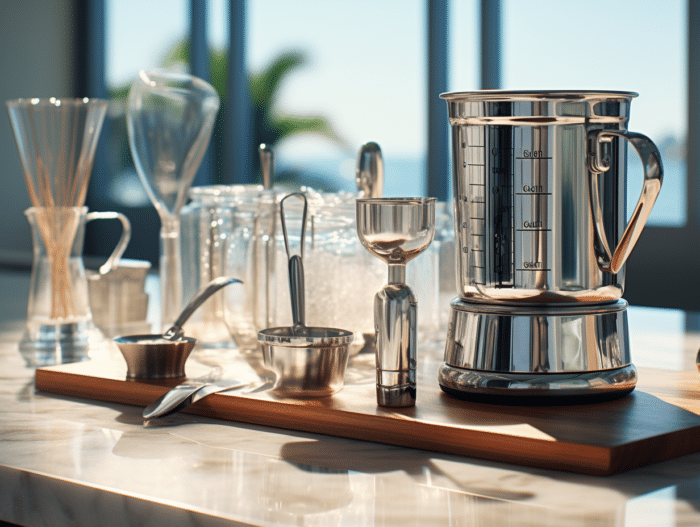
Mastering the conversion of liquid measurements is essential for anyone passionate about cooking. This skill allows you to adapt recipes to different scales, whether it’s to reduce portions for an intimate dinner or to increase them for a large gathering. The variations between the metric and imperial systems can be confusing, especially when juggling between milliliters, liters, ounces, and pints. Fortunately, tips and methods exist to simplify these conversions, ensuring accuracy in dish preparation and contributing to the success of all your culinary endeavors.
The Keys to Converting Liquid Measurements in Cooking
In a cook’s arsenal, knowledge of measurement units is as fundamental as handling a knife. One centiliter is equivalent to 10 milliliters, thus simplifying the conversion between these two units frequently used in cooking. Using a measuring cup or a measuring spoon allows for a quick estimate without resorting to complex calculations. Precision is crucial when the success of a recipe depends on the accuracy of the proportions.
The reverse conversion, from milliliters to centiliters, is done by dividing by 10. This method offers a considerable advantage for adapting foreign recipes that often favor the metric system. For larger quantities, convert milliliters to liters by simply dividing by 1,000. Conversely, one liter converts to milliliters by multiplying by 1,000. Equip yourself with an appropriate measuring tool and follow these simple rules to avoid any approximation.
Each measuring utensil has its own capacity: a mustard glass typically holds 25 milliliters, while a liqueur glass contains 35. These common culinary accessories can serve as a quick reference for measuring liquids without needing a precise measuring instrument. Be mindful of variations that may exist from one manufacturer to another.
Online converters represent a modern alternative for connected cooks. They offer instant conversions for a multitude of units, especially when it comes to converting ‘100 ml to grams’, an operation sometimes necessary for ingredients with varying densities. Favor these tools for immediate results and to bypass the challenges associated with complex conversions. Keep in mind that the density of liquids can influence the conversion to grams; a factor not to be overlooked for precise measurements.

Practical Tips and Conversion Methods Without a Calculator
In the world of gastronomy, mastering the conversion of measurement units proves to be a fundamental skill. When faced with a measuring cup or a measuring spoon, simplicity prevails. To convert centiliters to milliliters, multiply the amount by 10, a mental operation easy for any cooking professional. 5 centiliters instantly become 50 milliliters, without the slightest hesitation.
Conversely, to convert milliliters to centiliters, the process requires dividing by 10. An equally straightforward exercise that needs no electronic assistance. In practice, 250 milliliters transform into 25 centiliters, a quick conversion for adjusting recipes that require this unit.
As volumes increase, converting milliliters to liters proves just as trivial: divide by 1,000. This rule of three, inseparable from daily cooking, allows for measuring liquids in large quantities with remarkable precision. For example, 2,000 milliliters convert to 2 liters, a calculation at your fingertips.
Online converters are valuable allies in measurement conversion. They are particularly useful for less common operations or for cooks less comfortable with mental calculations. They provide immediate results, ensuring flawless accuracy for preparations where every detail counts. However, be cautious with conversions involving ingredients of variable density, an essential consideration for measurements true to reality.