When embarking on culinary arts, juggling with units of measurement can prove to be a challenge, especially when recipes alternate between milliliters and grams. Mastering the conversion of centiliters to grams is essential for anyone wishing to perfect their preparations. This skill is particularly relevant in baking, where precision reigns. You need to understand how to transpose these volumes into weights, knowing that the density of ingredients influences the final result. This conversion tip is an invaluable asset for any cooking enthusiast eager to expand their repertoire of international recipes.
Mastering Measurement Conversions in Cooking: from cl to grams
In the culinary field, converting centiliters to grams is a common operation that requires special attention. The relationship between volume and weight varies depending on the density of the ingredients. Converting 60 cl to grams will require different calculations depending on whether it is water, flour, or oil. For example, for water, this conversion is straightforward: 60 cl corresponds to 600 grams. However, when considering butter, the conversion requires a specific formula, knowing that 29 cl equals 250 grams.
Each ingredient has its own characteristic that influences its conversion from volume to mass. Take white sugar, for instance: 1 liter weighs 833 grams, which means that centiliters convert to grams at a different ratio than water. This distinction is fundamental for following recipes accurately, especially in baking where every gram counts.
For oils, the subtlety lies in their slight difference in density. 1 centiliter of olive oil weighs approximately 0.91 grams while the same amount of sunflower oil weighs 0.92 grams. These nuances, although minimal, become significant when multiplied to reach larger volumes. Consider these variations when converting measurements to ensure the authenticity and quality of your preparations.
The white wheat flour (T55), often used in cooking, also requires special attention. One liter of this flour weighs 550 grams, meaning that each centiliter converted to grams represents only 5.5 grams of flour. Anticipate these conversions when planning your recipes. Precision in dosing is crucial for achieving satisfactory results and maintaining the original flavors of the dishes.
Tips for Accurate Conversions Based on Ingredients
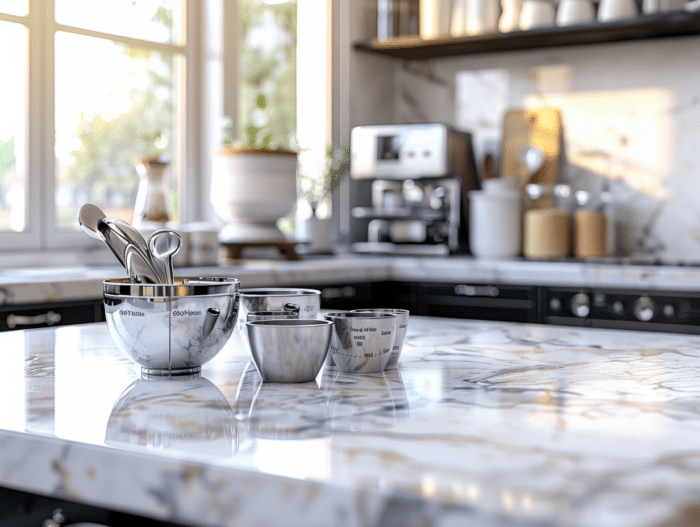
To make precise conversions, the arsenal of the cook, pastry chef, or chef is equipped with essential tools such as the kitchen scale and the measuring cup. The kitchen scale is indispensable for measuring masses accurately. It allows, for example, to weigh white sugar where volume would be misleading. Indeed, a cup of sugar does not weigh the same as a cup of flour due to their different densities. The measuring cup, on the other hand, is ideal for measuring liquids, ensuring that 10 centiliters will always equal 100 grams of water.
In the case of small quantities, the tablespoon becomes a valuable ally. It offers a practical and quick equivalence for ingredients such as oils, where one tablespoon represents about 15 milliliters, or approximately 13.5 to 14 grams depending on whether it is olive or sunflower oil. Everyday utensils, such as a yogurt pot or a mustard jar, can serve as references for more approximate measurements but require knowledge of their volume for reliable conversion.
However, the precision of these tools must be combined with an understanding of the specifics of each ingredient. Dark chocolate, for example, has a density close to that of water, making its conversion relatively straightforward: 100 centiliters will correspond to 1 kilogram. This simplicity does not generalize, and each ingredient requires special attention when converting volumes to weights. Measurements in cooking are a balancing act between the accuracy of tools and the understanding of the properties of the ingredients used.