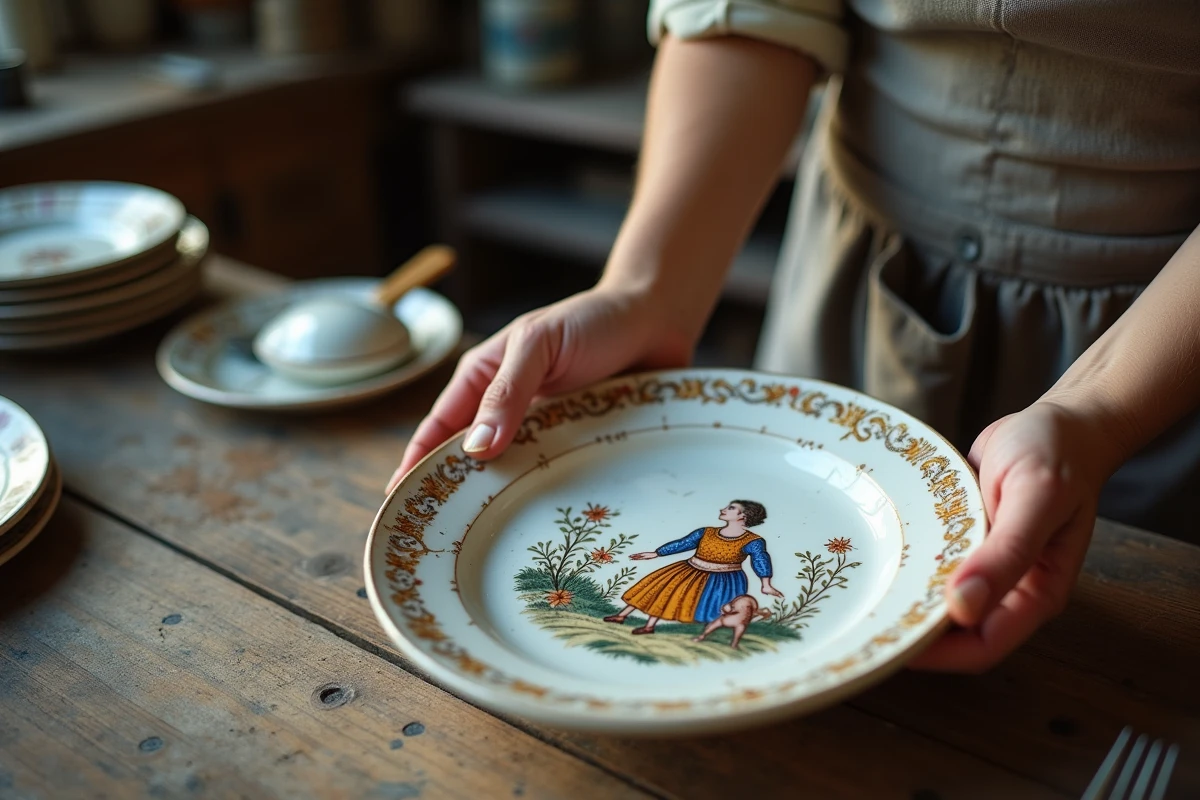
When returning a plate found at a flea market, one notices a hand-painted marking under the glaze, and the question arises: when exactly does this piece date from? With Henriot Quimper earthenware, the answer comes from a combination of several clues, not just a single stamp. Signatures have changed over the decades, designs have evolved, and reissues regularly blur the lines.
Henriot Quimper Signatures: What the Bottom of the Piece Really Tells
The first instinct when trying to date a Henriot earthenware piece is to flip it over. The painted or stamped signature under the glaze serves as the starting point. Henriot-Quimper has registered numerous signatures throughout its history, and the factory itself provides them to allow for an estimated dating.
Emphasis is placed on the word “estimated.” A signature provides a range, not a precise date. Hand-painted markings vary from one painter to another, and some stamps have been used over long periods. Before drawing a conclusion, one must know how to date a Henriot earthenware piece by cross-referencing the signature with other material clues.
Here are some concrete markers regarding the markings:
- The oldest pieces often bear a handwritten signature, sometimes difficult to read, traced with a brush under the glaze with variations in thickness and script.
- Printed stamps (inked seal or decal) appear on later productions and generally indicate a more industrialized manufacturing process.
- The presence of a serial number or a shape code associated with the signature is an indicator of mass production, typical of the 20th century.
A signature alone is never enough to date a Henriot earthenware piece. It is the combination with the decor, shape, and glaze that helps narrow down the period.
Hand-Painted Breton Decor: Distinguishing Eras by Style
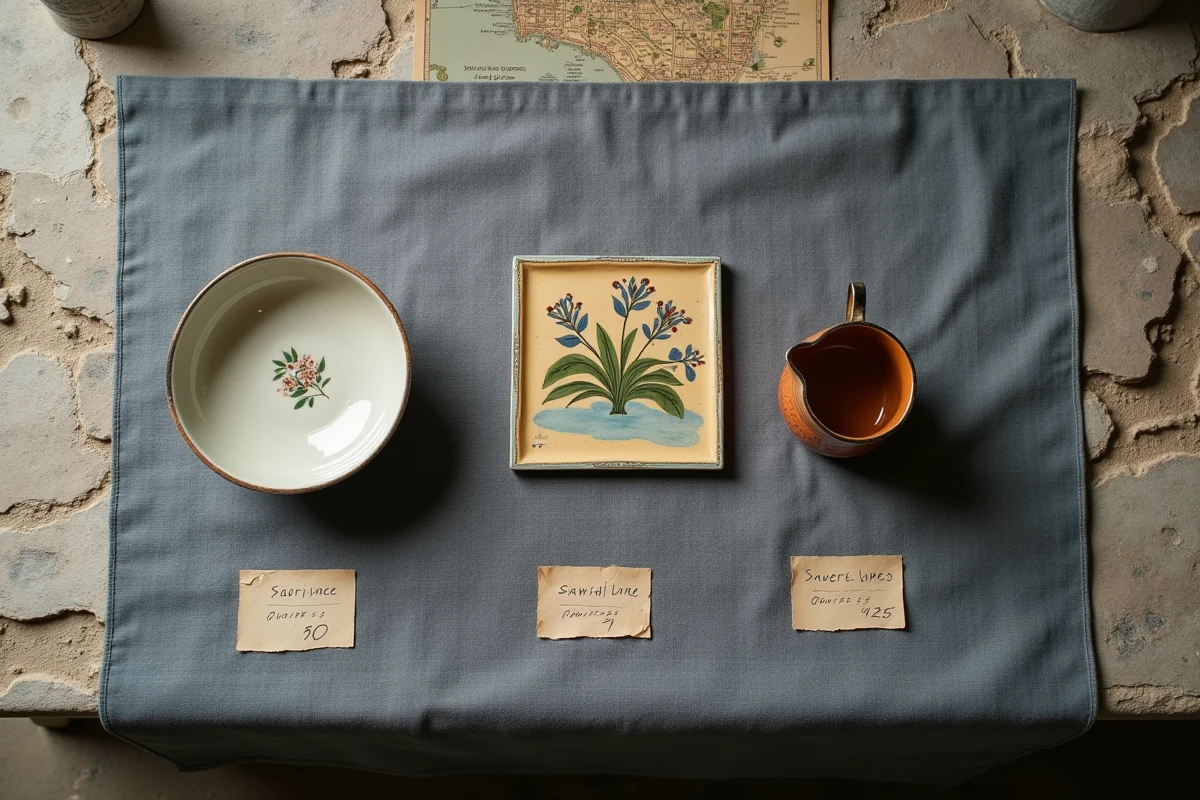
The decor featuring the “Petit Breton,” created around 1860 according to historical sources, has become the emblem of Quimper earthenware. This motif has given rise to numerous variations and imitations over more than a century. To date a piece, one does not only look at the subject represented but also at the manner in which it is painted.
Brush Stroke and Color Palette
On older pieces, the brush stroke is often freer, with visible lines and a certain irregularity that betrays the hand of the artisan. The dominant colors (cobalt blue, antimony yellow, copper green) remain fairly consistent, but their intensity and brightness change according to periods and pigment suppliers.
A decor that is too regular or too smooth suggests a recent production or a reissue. Old Henriot pieces often bear slight smudges, uneven paint thickness, and sometimes a slight misalignment between the outline and the filled color.
Composition and Borders
The floral borders surrounding the central motif have also evolved. On productions from the first third of the 20th century, particularly those from the 1920s-1930s still in circulation today, one finds stylized garlands with geometric patterns typical of Art Deco. These border details serve as fairly reliable chronological comparative markers.
Glaze, Biscuit, and Wear: Physical Clues That Photos Don’t Show
Dating by photo or online resale announcement has its limits, and this is a point that most guides overlook. Certain physical characteristics can only be perceived by handling the piece.
The thickness and texture of the glaze provide valuable indications. An old glaze often shows fine cracks (the “craquelure”) that result from natural aging. This network of cracks is difficult to reproduce artificially and serves as a good marker of age.
- The biscuit (the visible earthenware under the glaze, especially at the foot of the piece) can vary in color: a pinkish or tawny biscuit points to certain production periods, while a very white biscuit is often more recent.
- The natural wear of the edges and the bottom of the plate (knife marks, micro-chips from use) does not confuse with artificial aging, which affects the piece too uniformly.
- The weight of the piece can also vary: old earthenware is sometimes heavier, as the clay is less refined than in contemporary productions.
Opinions vary on this point, but it is generally observed that the combination of craquelure with consistent wear remains the best physical indicator when one does not have access to documentation from the factory.

Reissues and Copies: Common Traps in the Quimper Earthenware Market
The Henriot-Quimper factory still offers reproductions of old decors today. These reissues are legitimate, but they complicate the task for the collector seeking a period piece. The current catalog explicitly mentions “reproduction of old decors” among its offerings.
At flea markets or online, one also encounters earthenware from other factories (Malicorne, Desvres) that imitated Quimper productions as early as the 19th century. The competition between these factories has left the market with pieces that are sometimes difficult to attribute.
Cross-referencing signature, decor, glaze, and shape is the only reliable method to avoid confusing a recent reissue, a copy from another factory, and a genuine old Henriot piece. A single one of these criteria taken in isolation is not sufficient.
The most useful reflex remains to compare the examined piece with documented examples, whether in the collections of the Quimper earthenware museum or in reference catalogs. In the field, a pocket magnifying glass and good side lighting often do more than any online research.