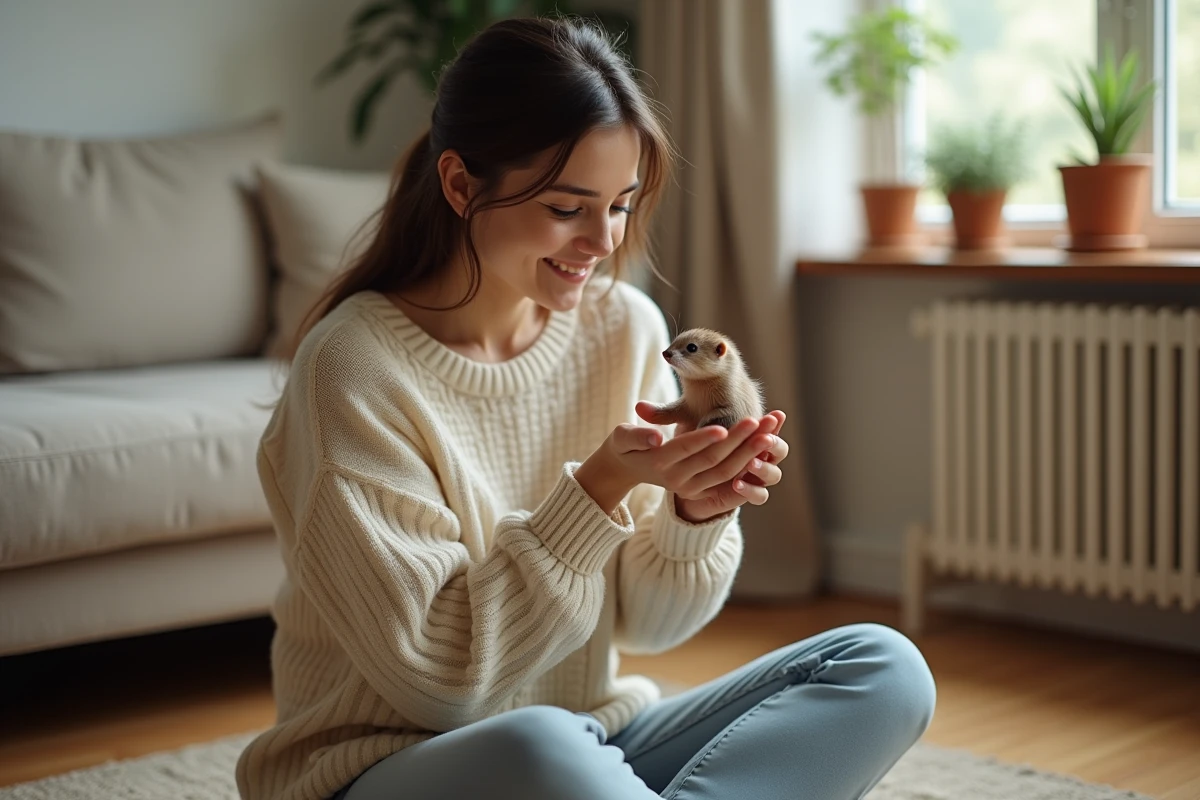
When you come across a video of a weasel playing in a living room, the instinct is immediate: you want one at home. The problem is that a weasel is not a ferret. This confusion, fueled by social media, leads individuals each year to acquire a wild mustelid without understanding the legal, veterinary, and behavioral constraints that come with it.
Weasel and ferret: a confusion that costs animals dearly
The ferret is a recognized domestic animal, bred for centuries to live alongside humans. The weasel, on the other hand, remains a wild species. Despite their family resemblance (both are mustelids), their temperament and needs are not comparable.
A ferret accepts handling, adapts to an apartment, and eats specialized kibble. The weasel requires a diet of whole prey and a hunting space that no indoor environment can replicate. Exotic animal veterinarians who see these animals report recurring issues of malnutrition, chronic stress, and aggression, precisely because the diet and domestic environment are unsuitable.
For those looking to understand this growing fascination, one can read all about the domestic weasel and gauge the gap between fantasy and reality on the ground.

European regulations on weasel ownership
In Europe, the regulatory trend is clear. Several countries have recently tightened or clarified their positive lists of permitted pets. Wild mustelids, including weasels, are increasingly excluded from these lists and reserved for declared establishments: zoos, wildlife rehabilitation centers.
The reasons cited by authorities are twofold:
- The risk of zoonoses, diseases transmissible between wild animals and humans, which are difficult to control outside a professional health framework.
- The predation on local small wildlife in case of escape or release, as the weasel is a strict carnivore capable of decimating populations of rodents and small birds in a given territory.
- The impossibility of ensuring the well-being of an animal whose natural hunting territory covers several hectares, in a living space of a few dozen square meters.
Regular seizures by veterinary services and customs remind us that ownership remains legally subject to specific authorization, even for an animal raised in captivity. Buying a weasel online does not make it legal.
Why rehabilitation centers discourage the adoption of weasels
Wildlife rehabilitation centers are the first to witness the damage. They receive weasels kept indoors for a few weeks, sometimes a few months, by owners overwhelmed by the animal’s aggression or unable to feed it properly.
The observation is straightforward: a mustelid kept indoors quickly loses its hunting and fleeing abilities. A few weeks are enough. The animal no longer knows how to track prey, no longer reacts correctly to a predator. For reintroduction programs, this is a major problem.
An animal that can neither return to the wild nor live in captivity under good conditions finds itself in a deadlock. Rehabilitation centers have neither the space nor the means to keep mustelids that have become unfit for wild life indefinitely. Returns vary on this point, but most caregivers consider that the complete rehabilitation of a weasel that has lived in an apartment remains exceptional.
What the domestic environment cannot offer
The weasel is a hyperactive hunter. Its metabolism requires frequent feeding, based on whole prey (mice, voles, small birds). No kibble, no industrial pâté. In domestic captivity, the diet is almost always unsuitable, leading to severe deficiencies within weeks.
Space poses an equally fundamental problem. A ferret can be satisfied with a playpen and daily outings. A weasel needs a hunting territory, not a living room. The lack of stimulation causes visible chronic stress: self-mutilation, stereotypical behaviors, repeated bites on the owner.
The ferret as a legal and suitable alternative
For those attracted by the charm of mustelids, the ferret remains the most coherent option. A domestic animal since antiquity, it has a temperament compatible with indoor life. Its diet, although specific (meat-based, rich in animal proteins), is accessible through specialized ranges.
Some points to check before adopting a ferret:
- Identification by microchip is mandatory in most European countries, and rabies vaccination is often required for travel.
- The ferret needs several hours of daily time outside its cage, with a secure space (electrical cables, small objects to swallow, escape routes).
- Spaying is highly recommended for females, as prolonged estrus without mating can lead to potentially fatal aplastic anemia.
The ferret offers the essence of what is appealing about the weasel (liveliness, curiosity, compact size) without the legal constraints or risks for the animal. It’s a compromise that works, provided you invest time and attention into its daily life.
The fascination for the domestic weasel is based on a misleading image. Behind the expressive face and heartwarming videos lies a wild animal whose needs are incompatible with a household. The ferret, on the other hand, is already waiting in a shelter.